Showing posts with label sheep. Show all posts

Saturday, June 19, 2010

R.I.P. Abby

We had to put our Jacob ewe down this morning.

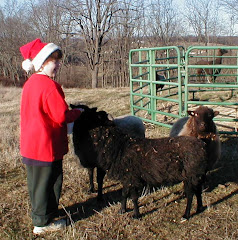
Abby (short for Abilene -- she was named for her hometown, a small Virginia crossroads where she was born over 12 years ago) was a one-of-a-kind sheep.  She never completely lost her wariness of people though she learned to like animal crackers, a frequent sheep treat around here.  And only in the last few years did she stop giving DH a real run for the money when it came time for shearing and other routine care such as foot trimmings or wormings.  More than once she's leaped over the 4-ft gates he set up behind the barn to facilitate capture.  The other sheep would gather docilely at the gate after being herded into the pen but not Abby.

We still laugh, DH not so loud, about the time she leaped right over him on a successful attempt to get back out to the field and away from the shearing pen.  The funny thing was, once she was in the hands of the shearer (usually DH tho we hired a local Virginia Tech student till DH had a chance to take the 2-day VA/NC Shepherds Workshop then offered down the road at VT's Shenandoah Valley Ag Research and Extension Center at Steeles Tavern), she was a different sheep.  Calmly she'd accept her fate and let herself be flipped first one way then the other as the shearer worked to remove her lovely thick coat.  Her springy wool made a pretty heathery black yarn as the small splotches of white and brown in her coat blended with the rest of her mostly black wool in the final product. (Her coat would sunburn on the tips making her look more brown as the wool locks lengthened after each shearing but underneath was a rich black.)

Because of her coloring, black legs, black face with a wide white stripe down the middle and a mostly-black coat with a few white and brown patches, many people thought she was a goat on first (or even second) sight -- especially right after shearing when no thick wool gave her away.  But we knew she just acted like one. (Myself, I always thought she looked like a holstein calf after shearing.)  And as the smallest of the sheep, year in and year out, she would bounce around, trying to exert her dominance, when the others were sheared each spring.  I think it's because sheep always look so much smaller right after the shearer finishes and Abby imagined she was now (finally!) the biggest of the flock.

Abby was the sheep that hung back when the others gathered 'round for their treats.  She often stayed on the far side of Andy, the guard llama, using him as a shield in case anyone should try to make a grab for her.  But with lots of coaxing, over more than a year, animal crackers became too much for her to resist and she finally succumbed to closing in enough that she could share in the bounty, too.

With age, though, she became less agile.  We could tell that a couple of years ago when she began putting up only a token chase at shearing time and completely ceased jumping the gates.  Early this spring, before DH sheared, she'd even gotten down several times and was unable to stand again without help.  Each time it happened, one of us would have to go out and hoist her to her feet. 

The good news was it seemed to help her lose most of the remaining shyness with people.  Since we'd moved the sheep closer to the house after a serious coyote scare early this past Mother's Day morning, Abby'd even baa and call to us as the other sheep do when we'd be out and about in the backyard -- reminding us that animal crackers were always welcome, I think.  We hoped the mobility problem would go away when she was no longer encumbered by her heavy fleece but it didn't and veterinarians, like any other medical doctors, can only offer so much help.  It was time.

Sunday, May 23, 2010

4 and counting...

While the sheep feigned indifference, Snowball, the white Silkie pullet, came through her marathon broody spell with 4 chicks hatching today.  Poor thing started out brooding almost 5 weeks ago but every day when she left the chicken house to grab her once-a-day meal, another hen would add an egg to her nest.  Soon she had over a dozen eggs and she couldn't keep them all covered.  So we cleared those eggs out and gave her 6 fresh eggs and a house of her own on May 1.  May 2 we added one grey silkie egg from our new pair.

Around mid-morning today we spotted this little black-and-white Dominique chick poking his (her?) head out from under Snowball.  By noon there were three more chicks added to the brood: 2 Turkens and a chipmunk-looking one which is probably a green-egg layer.  (All the full-size eggs placed under Snowball were brown but in addition to Cappy, the Dominique rooster, we had Brownie, a green-egg layer rooster, in the pen from which the eggs came.)

One Turken is a yellow-white fluffball and the other is very similar in coloring to the chipmunk-looking chick except it has the trademark naked neck. Maybe it will be a green egg layer, too?

Snowball wouldn't come off the nest even to eat today so I'm thinking there might be one or more eggs she's waiting to hatch. Stay tuned.

Wednesday, October 28, 2009

"Life is pleasant. Death is peaceful. It's the transition that's troublesome." -- Isaac Asimov

Fifi, the white Silkie hen, went missing this week. All we've found are clumps of fluffy white feathers in a long trail leading away from her favorite egg-laying spot towards the fence. She had taken to laying her eggs near the old apple tree in a little leafy spot she created just for that purpose instead of in the chicken house. It was off to one corner of our field-fenced backyard, away from where the other backyard girls and chicks typically hang out.
Our neighbor's farm pond hosts a fox den. He can watch the kits play there every spring. We've heard the local band of coyotes howl on the other side of the field behind us -- maybe 1/2 mile away. DH surprised what he thinks was a speedy coyote in the fenced backyard late one evening. Andy, the guardian llama, makes sure the sheep are up near the open barn when it's time to turn in at night. He positions the sheep between the barn and himself so he's always on guard. DS and I found a young skunk in the chick pen and, on another occasion, a full-sized skunk inside the electric poultry netting when we went out to close the houses up earlier this summer. We had a feral orange cat this summer who tried to catch the small chicks on occasion. There are predators all around us.

But secretly I've always believed they wouldn't kill any of our animals. You know, I suffered from a variation of the NIMBY or not-in-my-backyard syndrome even though earlier this summer, Petrock Trelawney's hatchmate, a little cockerel who wasn't around long enough even to secure a name such as Stewpot or Potpie went missing, too. We never found feathers or any sign of what happened to him but he and Petrock (photo on left) had developed the bad habit of hanging back instead of going straight into the house at night. DS and I would have to shoo the two of them in, sometimes resorting to waiting till they had settled into a bush or low-hanging tree branch then plucking them off their perch and stuffing them in the house. One night we couldn't find the cockerel. Either he was well-hidden (to us, at least) or he'd already been nabbed. Whichever way, he was still missing come morning so we concluded he had been devoured by some hungry animal.

Fifi will be much missed. She was the best mama hen we've had. Regularly setting on a hatch even in the coldest weather. Always shepherded her fledglings with the stereotypical "mother hen" approach. She stood up to the "big girls" and kept them from bothering her chicks. Even taking on Turkey, the naked neck hen and backyard leader, for their sake. Fifi's sometimes feisty attitude towards other chickens, her blue bill and earlobes (typical of Silkies) and her general cocky yet friendly stance towards us, her people, made her stand out amongst the other backyard girls.

At not quite 6 months old, her daughter, Snowball, hasn't yet shown any indication of broodiness or the strong personality Fifi exhibited but I hope she grows to fill the space her mother left not only in our hatching scheme but in my heart. I miss Fifi. We all do.

Wednesday, February 4, 2009

Needle felted sheep


These little guys are fun to make. They only take one felting needle and about a 1/2 ounce of wool each.

I used a triangular needle, 38 gauge, but there are other types. Two were made from wool roving but the white sheep was made from washed fleece. The bit of pink-colored wool used inside the ears of two of the sheep came from a bit of Kool-Aid dyeing I did a while back. I used about 2 inches (total) of a 4-ply black tapestry wool yarn for forming the mouth and nose on each sheep. One of the sheep has two tortoise-shell beads sewn on for eyes. The others are waiting for me to find suitable small beads in my stash.

The process of needle felting is fairly simple. After deciding what you want to make, break the overall form down into a few basic shapes. (Yes, this is like those drawing lessons where you are to imagine heads as ovals or spheres, legs as cylinders, etc.) In the case of these sheep, each one required 9 individual pieces: 4 same-size cylinders for the legs, 1 large cylinder for the body, a somewhat cone-shape for the head, and 3 flat leaf-shaped pieces for the two ears and the tail.

Take small amounts of wool, mere wisps in many cases, and roll them into the shapes you need. For legs you may want to roll the wool around a wooden skewer or even a toothpick if the animal is small. Then use the felting needle to run through the wool. Over and over again.

You'll notice after the first few tries that the wool compacts where the needle penetrates it. The form will go from being loose and airy, like a light cotton puff, to being more firm. More like one of those cylindrical cotton pads a dentist uses to pack around a gum. Leave a bit of loose wool at the end of the leg where you plan to attach it to the body. Then needle that bit in and out to attach it securely.

Remember that the felting needle is very sharp and barbed. You don't want to accidentally run it through you in the process. Using a foam pad as a working surface is what's most often recommended.

The pad should be thick enough that the needle doesn't extend past the pad when poking it into the wool. Another reason for using a pad is that the action of the needle hitting a hard surface like a tabletop could cause the needle to break. High-density foam (available at some craft stores), upholstery foam such as used for couch cushions or firm pillow forms, and even the packing foam used for electronic equipment can work for this purpose. Just don't use styrofoam or similar substance that will crumble when penetrated by the felting needle.

Instead of a foam pad, I've been using a folded Shetland sweater I fulled in the washing machine. (The sheep are standing on it in the photo above.) Folded, it offers a decent surface for stabbing at the wool. Drawbacks, which haven't bothered me so far, are every so often I have to pick a few hairy strands of wool from the sweater off of the sheep piece I am working on and the working piece and pad can stick together like they've been velcroed if I'm not careful about pulling up the working piece every few jabs. The last problem isn't one for me as I like to turn the working piece in my hand after every few pokes with the felting needle to be sure it's felting evenly and that the shape is staying as I want it. Not flattening out, for example.

DH wants to try this craft and is determined he's going to make a llama so we can have a flock of needle felted sheep made from our sheep's wool with a guardian llama just like Andy, too. For me, I want to try working with some dyed wool, perhaps making a sun, moon and stars mobile or a fiery-faced sun with wool locks coming out from his head like sunbursts.

Later this month I'm going to do a short class on making these sheep for my fiber guild's meeting. Since the other members inspire me with their hand-dyed tops, lacy shawls, inkle-woven shoelaces, etc., I've decided to work up a white sheep/black sheep needle felted design for the yoke or bottom edge of a long-sleeve denim shirt I found at the thrift store last month. What better way to demonstrate the many uses of a felting needle, right?

Saturday, January 26, 2008

What's a gigli wire used for anyway?

DH has learned to use a new tool. It's called a gigli wire and it's a surgical instrument used to cut bone or, in this case, horn.

Two of our Shetland wethers have horns that needed trimming. I knew we needed a gigli wire to do the job but didn't know where to buy one. The local farm store, which stocks all the usual med supplies, said they hadn't carried them in years. I guess horned livestock aren't as popular as they used to be? Who knows.

Ended up ordering one from a surgical supply store down the road in Roanoke. There was a few weeks delay as they had to order from the German manufacturer but finally it came in the mail.

The saw looks like a piece of woven wire and has a ring on each end. You can buy a type of handle to put thru the rings but DH fashioned his own with some duct tape and a couple of large nails. The wire is wrapped around the horn and crossed so you draw back and forth on the wire from each side so it saws thru the horn.

It's very fast -- takes more time to describe the action than to saw the tip off one horn. The vet had told me we could take off up to 1-1/2" of horn from each horn end or, to measure from the skull, leave about 5" of horn on the sheep. The idea is to not cut into the quick, the blood vessel that runs through the middle of the "live" part of the horn. So it's like trimming a dog's nail only the horn is too dark to be able to see the vein as you sometimes can in a dog's nail.

Considering the vet would charge $175 to do the job and the gigli wire cost less than $15 including shipping and took about 20 minutes of DH's time, I'd say DH made a wise decision when he decided to learn another shepherding skill.