Wednesday, June 16, 2010

Holly-dog meets a skunk: the aftermath

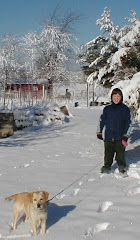
Holly-dog met a skunk.  It was not an amicable meeting.  Holly-dog had to have a bath. Immediately.

Always before I've used tomato juice to wash a dog that was sprayed by a skunk but this time DH used a recipe I'd clipped from Country Living. It's inexpensive, I had all the ingredients on hand and I thought it might be easier to wash out of her fur than home-canned tomato juice. I won't know for sure till she gets wet again but this seemed to do a good job.

Dog Bath for Skunk Encounters

32 ounces hydrogen peroxide
1/4 cup baking soda
1 tablespoon shampoo or dish detergent

Mix together right before use. Mixture may fizz or build up pressure in tightly-closed container so don't plan on storing it for another time. Use it all.

Wash, rinse and repeat if you still have soap mixture. Let mixture stay on fur for 5-10 minutes before rinsing.

Bath time is not a favorite with Holly but she's usually very stoic about it. Today you might even say she enjoyed it as DS had something with which to bribe her.
Some friends are on the path to a second adoption from Africa. One of their daughters is contributing to the effort by baking and selling "Rachel's Beefy Biscuits for Dogs." Holly-dog thought they were spot-on.

Wednesday, June 9, 2010

Surprise! Look what Bandit hatched.

Yes, it's a chick but it's still a big surprise.  We only noticed Bandit was broody last week.  Bandit is a backyard girl, a 9-mo pullet who was herself hatched by Fifi late last summer.
Apparently she was stealthily broody long before last week.  (It takes 23 days to hatch a chicken egg.) And she's an egg thief, to boot.

Unless we swap out the backyard girls' eggs with some likely-to-be-fertile eggs from the hens in the mobile coop, their eggs won't hatch.  Well, except for Mrs. Badger's eggs.  She's a little grey Silkie we added to the backyard on April 30 along with her mate, Badger,  He halfheartedly tries to cover one or two of the fullsize backyard girls but let's just say he hasn't gotten the hang of it yet.  So Bandit must have swiped one of Mrs. Badger's eggs and added it to her nest.

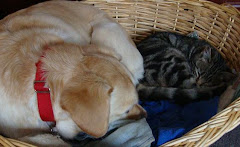
So what Bandit hatched is a little grey Silkie.  What a turnaround.  In one chick pen we have Bandit, a full-size hen, with her suspected bantam chick.  And next door, in another chick pen, is Snowball, a little white Silkie, and her now-2-and-a-half-week-old chicks who will grow up to be full-size chickens.  (Looking like 2 cockerels and 2 Turken pullets but time will tell.) 
And we can't forget Echa, the 3yo Turken and first-time mother in the mobile pen, who decided it's never too late to try hatching an egg. She sat on four eggs in one of the raised nest boxes in the wheeled coop but only one egg hatched. Mama hen and chick are doing fine in the third chick pen we set up, this time inside the electric netting. 

DS is ecstatic that we have Turken chicks. He's hoped for that ever since we got the three original Turkens (Turkey, Echa and Misha) as part of a day-old chick order. DH is very pleased that "his girl, Echa" came through with a chick after several weeks of impatient waiting. And I'm trying to figure out how we can set up another two chick pens because Mrs. Badger, the grey Silkie in the backyard, and Amelia Earhart, one of the new Turkens added to the mobile pen April 30, are both determined to brood their eggs. When it rains it pours.

Thursday, June 3, 2010

Preserved Bean Sprouts (dua gia)

3 cups water
1 tablespoon salt (pickling salt or 1-1/4 tablespoon kosher salt)
1/2 teaspoon granulated sugar
1 pound mung bean sprouts, rinsed and drained
1 carrot, cut into very thin strips or shaved with a vegetable peeler

Bring water, salt and sugar to a boil in a small saucepan.  Remove from heat and let cool to room temperature.

Pack the bean sprouts and carrot shavings together in a 2-quart jar.  Pour the cooled brine over the vegetables and cover the opening with a towel.  Don't worry if  the brine doesn't cover the veggies completely to begin with.  After an hour or so the liquid and vegetables will equalize or you can press the veggies down with a spoon to get them below the level of the brine.  Cover the jar loosely and let it stand on the counter at room temperature for 3 days.  Taste to be sure the bean sprouts are sour enough, then cap the jar tightly and refrigerate it.  The sprouts will keep for 3-4 weeks.

Wednesday, June 2, 2010

Lots of pickles but no cucumbers yet.

When I was a kid, pickles meant pickled cucumbers. Even pickled beets weren't really considered pickles. But now when I think of pickles, my mind races with the possibilities.


The sugar snap pea vines are producing like mad.  We pick in the morning and by the next evening the vines look loaded again.  Monday I prepared a batch of Pickled Sugar Snap Peas from Linda Ziedrich's The Joy of Pickling, Revised Edition: 250 Flavor-Packed Flavor-Packed Recipes for Vegetables and More from Garden or Market.  The directions say to let them set in the fridge for 2 weeks but DS and I tried them last night (barely 24 hours) and they're tasting pretty good. Maybe they'll last long enough to try them at the proper time or maybe they won't.

Tuesday, while DH and DS went on another hike with the WILD GUYde, Lester Zook, and some other homeschoolers, I took advantage of the morning spent in Harrisonburg.  Besides the usual stops at the downtown library and A World of Good thrift store, I went by  a Taste of Thai's food market to pick up a few groceries. 
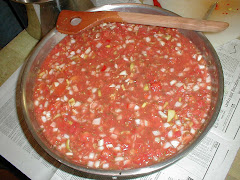
I bought lots of bean sprouts because I planned to make Ziedrich's Vietnamese Pickled Bean Sprouts plus Bean Sprout Salad in Outrageous Dressing, a great summer salad that becomes a main dish when I add cold cooked chicken or shrimp.  After setting on the counter overnight, the fermenting bean sprouts look like this and, after another day or two at room temperature, the taste will be pretty mild.  Makes them a good accompaniment to spicy or rich foods.

I cut up the last of the garden's daikon radishes for another fresh pickle so the refrigerator's full for the time being.  The beets are ready in the garden but I think I still have plenty of beet pickles canned and on the shelf from last year so they'll probably be prepared some other way.  DS and I like them steamed and plain but I might try something different to tempt DH.

Sunday, May 23, 2010

4 and counting...

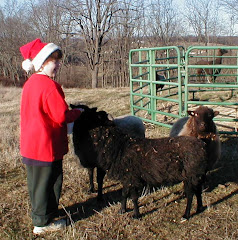
While the sheep feigned indifference, Snowball, the white Silkie pullet, came through her marathon broody spell with 4 chicks hatching today.  Poor thing started out brooding almost 5 weeks ago but every day when she left the chicken house to grab her once-a-day meal, another hen would add an egg to her nest.  Soon she had over a dozen eggs and she couldn't keep them all covered.  So we cleared those eggs out and gave her 6 fresh eggs and a house of her own on May 1.  May 2 we added one grey silkie egg from our new pair.

Around mid-morning today we spotted this little black-and-white Dominique chick poking his (her?) head out from under Snowball.  By noon there were three more chicks added to the brood: 2 Turkens and a chipmunk-looking one which is probably a green-egg layer.  (All the full-size eggs placed under Snowball were brown but in addition to Cappy, the Dominique rooster, we had Brownie, a green-egg layer rooster, in the pen from which the eggs came.)

One Turken is a yellow-white fluffball and the other is very similar in coloring to the chipmunk-looking chick except it has the trademark naked neck. Maybe it will be a green egg layer, too?

Snowball wouldn't come off the nest even to eat today so I'm thinking there might be one or more eggs she's waiting to hatch. Stay tuned.

Thursday, May 20, 2010

Dehydrator Diary - Socks and Mushrooms...


This week I found organic mushrooms marked down at the grocery. I spent about $15 and came home with 5 pounds of cremini mushrooms, 2 pounds of portobello mushrooms and a pound of shitake mushrooms. They were in very good shape so I put a 1/2-pound of cremini and a pound of portobello mushrooms in the fridge for a couple of meals later in the week. The rest of the mushrooms I prepared to put in the dehydrator.

But first I had to take out the socks that were in the dehydrator. Yes, for the second time in 5 days I've dried DH's wool kilt socks in the dehydrator. You see, it's too warm here for a fire in the woodstove but it's been raining. The socks are so thick they'd take more than a day to dry after handwashing (don't want them to felt so I eschew machine washing and drying) and the dehydrator racks offered good support. Drying went pretty fast; took about 4 hours at 105°F. and, since I add a drop or two of patchouli essential oil to the rinse water as an insect deterrent, the house smelled faintly of patchouli for several days. I like that, too.

Once the socks were out of the way, I spread sliced cremini mushrooms (or, according to the label, baby portobellos) and whole shitake mushrooms on the racks. Before slicing, I removed the stems and sliced them for drying separately. Sometimes they're tough but the flavor's good so I won't waste them but use when I'm going to puree or just need stock. I did the same with the portobello mushrooms, and because I only had a few of them, I mixed them in with the cremini. The dehydrator was full and ran overnight at 115°F.

Tuesday, April 27, 2010

Kale chips


Finally had a chance last week to try another suggestion from Mary T. Bell's "Food Drying with an Attitude: A fun and fabulous guide to creating snacks, meals and crafts" and made a double batch of kale chips in the dehydrator. I've seen mention of these things for a couple of years but didn't get around to trying them till now -- wish it'd been sooner as they are GOOD!

They're crispy, almost melt-in-your-mouth light and slightly salty. I followed Bell's directions and used a vinegar, olive oil and salt mixture to coat the chips before drying but DS suggested trying Old Bay seasoning next time. I can think of several seasoning blends worth trying but I'll have to wait till late summer as the chickens finished off the wintered-over kale when they were on the last garden section.

Besides rinsing any sand from the kale, I chose to remove the tough stem that runs up the middle of each leaf. They can become hard and tough after drying. But I did save them as Bell recommends and dried along with the kale chips, then ground to a powder, they'll make a tasty addition (like last week's post about ground carrot peels) to soups or other dishes. I'm thinking I should add a spoonful of the powder to the next batch of vegetable dip we make...

Kale Chips

4 cups kale (stems removed)
3/4 cup apple cider vinegar
1 tablespoon olive oil
1 tablespoon salt (I recommend reducing the salt, maybe by half?)

Cut kale leaves cross-wise into 1- or 2-inch pieces. They'll shrink while drying so don't worry if the curly leaves look over-large to start.

Mix vinegar, oil and salt together and pour over kale pieces in a bowl. Toss to coat. Let sit for about an hour, tossing every 15 minutes or so to make sure all surfaces are coated. (Bell recommends putting a weight like a large plate on the kale to press it into the liquid seasoning -- this would relive much of the tossing I had to do but my container wasn't shaped to allow this.)

Spread the kale pieces on the dehydrator shelves and dry at 125º-135ºF. till kale is crispy-dry. Depending on variables, it could take from 4 hours to overnight. Mine took about 8 hours to get to the right crispness.

Notes: I liked the cider vinegar but think any vinegar would work. Red wine or a flavored vinegar, like garlic, would be good, too. If you double, the recipe (I did), don't double the salt (I didn't and I was glad).

Saturday, April 17, 2010

When 10 pounds of carrots yields 24 ounces

Stopped at the grocery the other day to get olive oil (50% off regular price--YAY!) and found they had two pound bags of organic carrots marked down to 50¢. The store often has fresh produce marked down as it "ages" but those carrots looked as good as (if not better than!) the ones in my refrigerator crisper at home. So I bought 10 pounds.

When I got home I set DS to washing, then peeling them. I put a big pot of water on to boil and pulled out a knife and cutting board. DH brought the dehydrator in from the garage where it's stored in the off season.

First the peels went in the dehydrator on three shelves. Once upon a time I would throw them in the compost, then I learned to put them in a bag in the freezer along with onion skins and celery trimmings. Those vegetable scraps make an excellent addition to chicken broth fixings. When the broth's ready, I just strain out the cooked vegetables and then they go to the compost pile.

But having a dehydrator has changed that. Now when we need to peel more than a couple of carrots (the chickens get the small amounts) or other vegetables like onions, I dry the peels and grind them to make vegetable powders. You know, the basis for those seasoning blends that can cost a dollar an ounce at the store.

So this week, $5 worth of carrots (10 pounds) yielded 4 ounces of dried carrot peelings (small jar on right in photo) and right at 20 ounces of diced dried carrot pieces (quart jar on left in photo). I blanched the diced carrot before drying but not the peels. The pieces are perfect for adding to soup.

The peels were dried in their long form, just as they came from the carrots, but I crumbled them after drying to reduce their volume. Once I'm ready to use them in powder form, I'll either crush with the pestle and mortar or run them through a little electric coffee grinder. When I first started drying vegetables suitable for making powder, I made them into powder as soon as they were dry. But I don't add any anti-caking agents such as may be found in many store-bought salts or seasoning blends and even though I might vacuum seal the jars, I found the powder could make like a rock and become so hard I had to chip it out of the jar.

Dehydrating the carrots was a good warm-up for the coming growing season. Now that the dehydrator's out on the counter again I'm thinking about what else I want to preserve. There's rhubarb ready to pick and we're out of fruit leather so I think a batch of rhubarb juice for punch and the remaining pulp for fruit leather is a good idea. Also plan to can 10-15 pounds of dry pinto beans and a smaller amount (3 pounds?) of black beans later today. Just seemed like the thing to do as I have a ham bone to use up in the pintos and if I get out the canner for them I might as well do the black beans, too. So back to the kitchen for me...

Monday, April 12, 2010

Seedling update

The tomato seedlings have grown since we first transplanted them into newspaper pots on April 1. Although the nights have been chilly, with frost warnings, it's warm enough during the day to set the aluminum pans of seedlings outside on a wooden display rack (salvaged at the end of the growing season several years ago from Home Depot's garden center). The rack stands in a protected spot along a house wall and under the eaves. Gathers all the warm sun but keeps most of the wind off the seedlings. I think they like it. And I know it does them good to have real sunshine and just enough wind to build stem strength.

The hillbilly tomatoes are easy to spot with their distinctive leaf form. One can really see why they're called potato-leaf tomatoes...

The first seedlings, cabbages, lettuces, onions, lavender, broccoli and cauliflower are spending all their time outside now. Some have been planted in garden beds and some are waiting their turn, resting in their newspaper pots, on the warm soil in the cold frames. At the rate they're growing, we should have enough lettuce for a salad by the weekend.

Sunday, April 11, 2010

Saturday night at the drive-in

This was opening weekend for Hull's Drive-in down in Lexington. It's the country's only community-owned, non-profit drive-in and we've been members and supporters (and sometime-volunteers) of Hull's Angels since the beginning, 1999. But it seems we rarely get to go to the drive-in. Saturday night all the planets must have been in alignment because we made it.

Hull's is such a local favorite that even though we hadn't planned to meet up, some friends were already there and waved us into a spot next to them. Another family we know was on the other side so we had lots of visiting to do while the kids played ball and Frisbee in the grass in front of the big screen.

Growing up, when my family went to the drive-in, we made popcorn at home and put it in paper grocery sacks to take in the car. When we were all at home, we even took two bags, one for the front seat and one for the back. I normally try to keep that tradition alive but since I had a fiber guild meeting Saturday morning and DH was bottling apple butter with some friends, we ran out of time for food prep. Fortunately, Hull's has a great snack bar staffed by Hull's Angels volunteers.

It was a beautiful day for the drive-in and we started out sitting in front of the car in lawn chairs. That was great for visiting but when the sun sent down, the air cooled off and though we all wore jackets and some (me!) had blankets, we three ended up watching the movie from the car. There were many hardier souls who stayed out in the open, however.

We stayed for the first feature and, at DS's request, the short animated clips that have been shown between features for as long as I can remember but while DH and I might have enjoyed the second movie, it probably wasn't a good choice for a ten year old so we headed home. We have high hopes that we can make it back to Hull's later this summer. Just gotta get those planets in alignment again...

Thursday, April 8, 2010

The guinea who wouldn't leave...

Mr. Guinea is still here. He roosts in the smoke tree every night but gets back in the pen before we're up at daybreak to open the portable coop doors. He spends his day mixing with the chickens though the roosters tend to give him a wide berth.

Yesterday the neighbor from over the hill came by late in the afternoon to let us know one of our guinea fowl was over at his farmhouse. Wait, we don't have guineas.

After explaining the situation and discussing where the wanderer could possibly have come from initially, I went back to hanging clothes in the backyard. DS agreed that the guinea had come to us on the move and that was their nature so we were saddened but reconciled to losing Mr. Guinea.

When I finished with the laundry I came in grabbed a pan of extra buttermilk and a few oats I'd prepared for the chickens and headed out front with it. DS went along to turn off the charger. Surprise! Coming around from the back of the pen was Mr. Guinea (or Newt as DS's taken to calling him). He'd come "home" in time for tea.

DS swung the netting gate open and I led the way into the pen with Newt right behind. He immediately went for the buttermilk just like the hens while the roosters hung back though I did see Brownie with a white mustache after a few minutes.When should we stop considering Newt Guinea a guest and assume he's a resident?

Wednesday, April 7, 2010

Just like her mama?

Snowball, the white silkie in the backyard, went broody this week. DH slipped a few fertile eggs taken from the electric netting flock under her this morning so we may have chicks by the end of the month.

She's still just a pullet, not quite one year old, but she's already following in her mama's footsteps. I'm so proud.

Tuesday, April 6, 2010

Can we keep him, Mom? Please?!

Yesterday morning we heard a commotion coming from the chickens in the electric poultry netting. While DS and I went out expecting to witness an imminent predator attack, we instead discovered a guinea fowl walking around the yard near the chickens penned on the garden.

The roosters were trying to get the hens under the portable coop or feeding station and were glancing nervously over their shoulders at the marauder who was answering their danger-danger squawks with his own loud chit-chits. Once we were on the scene the hens began to quiet down and came out for their share of the chicken treats DS had grabbed on his way out the door. The guinea cockerel came closer to the electric netting and, after DS turned off the charger and I held up one of the fiberglass posts, went into the pen with the chickens.

Well, I didn't know what else to do with him and that seemed like a good option at the time.

After watching them for a few minutes and determining the guinea wasn't planning to take advantage of his size and bully the chickens, we went back to our regular chores. Throughout the day we checked on the guinea and I called a couple of neighbors to see if we could locate the guinea's owner, even calling the SPCA in case he'd been reported missing, but no luck.

The guinea made his chit-chit call almost all day. It was loud enough to be heard in the house but didn't seem to indicate any distress on his part. He mainly paced along the half of the pen the chickens alloted him. Once or twice he wandered near the feeders and waterers but mostly kept his distance. The roos definitely kept theirs! Anytime the guinea moseyed their way, the roosters practically ran over the hens to get out of his way. But he never offered them any violence or really seemed to notice them as individuals at all. By evening we'd discovered he particularly liked chicken scratch and that he stopped making his call while eating.

At dusk, DS and I donned long-sleeve jackets and gloves, expecting we'd have to bundle him into the portable coop when it was time to close the doors. But DS spotted the guinea near the top of the smoke tree when we went out. The smoke tree is near the garden but well outside the netting so he had to have flown over the fence and then up into the tree. He was about 15 feet off the ground and close to the end of a slender branch. Of course, the leaves aren't out yet so he was very exposed but we decided to leave him there for the night.

It stormed here last night. Lots of wind. Caused Holly-dog to push our bedroom door open and squeeze into her favorite spot for riding out storms -- under the bed. I woke up worrying about the guinea. DH promised he'd go looking for him in the morning.

This morning just after sunrise when DH went out to open the coop, the guinea was already down from the tree and back inside the ring of netting. He's decided he likes it here, I guess. And DS has gone from asking "Can we keep him?" to "Let's order some guineas when we order the baby chicks!"

Below is a video I shot when he first went into the chicken pen yesterday. Even with the sound of the breeze, you can clearly hear his chit-chit call over the usual clucks and crows from the chickens.

Monday, April 5, 2010

Two months and I'm learning to be thankful for the first housefly of the season...


On February 4, DS, accompanied by DH, attended a Carnivorous Plant Workshop at the Edith J. Carrier Arboretum and Botanical Gardens at JMU. He came home with a terrarium in which he'd planted five carnivorous plants (a venus flytrap, pitcher plant, and, I think, three sundews) provided by the workshop presenter. He had notes on how to maintain the terrarium -- when to feed, ideas on what to feed, how to collect snow or rainwater for watering, lighting needs, everything except a supply of insects.

We still had snow on the ground that week and by the end of the next week we had another foot added to it. Where's a bug when you need one?

DS's tried growing carnivorous plants before. For several years he would save his allowance for a few weeks before the local farmer's market opened for the season and purchase a venus fly trap from one of the market gardeners. Unfortunately, though he assiduously cared for each one and reported back to the seller whenever we went to the market, none survived more than a few months. These are looking better.

The venus flytrap set a flower stem, one of the sundews is blooming and the pitcher plant has a big beautiful new pitcher. Or whatever you call it. The part that catches the bug.

The main difference seems to be DS collected snow for melting or rainwater for watering the plants. Previously, we used our well water, thinking that was better than the treated county water. Seems we forgot to take the minerals in the well water into account, neither the public water supply nor most well water is good for these guys.

Now the only problem is finding insects for the plants. I'm assured that once summer arrives the plants will earn their keep by dispatching fruit flies but for now excitement comes from finding a slow-moving housefly buzzing around early in the season.

(Photo below is current. Note decomposing apple bit in lower front, resting on, I think, a Lego. According to DS, it's supposed to draw in unsuspecting fruit flies... I'm not sure what purpose the Lego serves. Maybe it keeps the soil from getting gooey? Photo at top of post is from early March.)

Sunday, April 4, 2010

Tomato seedlings

This is what the tomato seedlings looked like on Thursday, April 1. Here's what they looked like today, Sunday, April 4. I'd recognize them anywhere, how about you?
Yesterday was so beautiful; I wanted to set out the seedlings to take their chances rather than keep them cooped up under the indoor lights. These days with temperatures in the 80s are so hard to resist. But with effort, I remember that our last frost date is often in early May and, only a couple of years ago, we had a hard freeze on May 30. So I resist temptation tho flowering bulbs are everywhere and the redbud trees, Nanking cherry bushes and tulip tree are exploding with blossoms.

Wednesday, March 31, 2010

Little girls' skirts


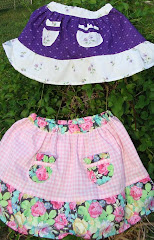
My mother's been clearing out some of her fabric stash over the last few months and while much of the cotton fabric is going into patchwork quilts she and my cousin are busily cutting and sewing, I used a few pieces to make adorable fun skirts for my niece's two young daughters. The pattern, called The Market Skirt, was as simple as could be and came from an online tutorial I found on the Dana-made-it.com site.

The red skirt was made to the specs included in the tutorial but the blue skirt, below, was for the oldest girl and required re-sizing. It wasn't difficult and the pattern is very forgiving anyway. I haven't seen pictures of the girls in their skirts yet but am told they couldn't stop twirling around and were unwilling to take them off so it sounds like I need to go back to Mom's stash and pull out some pink and purple fabrics to make the girls skirts in their favorite colors.

Saturday, March 20, 2010

First seeds up and repotted, more seeds in

Cabbage, broccoli and more all up and growing. Another flat, mostly tomatoes, started and a third (combination vegetables and flowers) going in today. May need more shoplights at this rate.

DH made paper pots. I made paper pots. DH filled paper pots with potting soil and carefully transplanted each seedling. I filled pots and transplanted but not carefully enough. So back to pot making for me.

DH prefers to separate any multiple seedlings and plant them individually in paper pots. It sometimes takes a steady hand to get the seedlings apart without breaking. I am not that patient. Besides, with 72 seedlings to a flat and sometimes almost double that with DH's careful attention to planting any multiples, someone needs to focus on pot-making and lots of them, too.

Thursday, March 18, 2010

Playing with fire

Today was Activity Day, a monthly cooperative sponsored by our local homeschool group, which offers a variety of classes for the kids. This year, one offering is a class using William Gurstelle's book, "Backyard Ballistics: Build Potato Cannons, Paper Match Rockets, Cincinnati Fire Kites, Tennis Ball Mortars, and More Dynamite Devices", as a text.

Today was also a beautiful day. Many of the Activity Day classes opted to spend the afternoon outside including the fiber arts class I teach -- I took wool roving and the kids used cardboard to create a resist in order to wet felt small bags. While we were out on the lawn working with the hot soapy water, netting and our pool noodle (more on that another day), the Backyard Ballistics class entertained us with their Cincinnati fire kites.

On the way home, I told DH and DS about the fire kites. As we prepared dinner, DS read the relevant chapter from his copy of Gurstelle's book. As soon as dinner was over, he took an armful of newspaper, a roll of scotch tape and a box of wooden matches outside to try his hand at making fire kites. DH and I followed him. Who wants to clean up the kitchen when one could be playing with fire instead?The first one was a failure due to not getting all four corners lit at the same time. But the next one was a great success.We used a single, full-size sheet of newspaper. Folded each corner in to the middle, starting with opposite corners first. Taped the corners together and tried not to crease the paper while folding. Two were better than one at this. Turned the packet over and lit all four corners at once. This definitely required more than one worker. Stepped back and watched the paper burn till enough hot air was trapped in the fiery packet to lift it off the ground and up, up and away.Then, after the ashy remains fell back to earth, DH and DS ran over and stamped it to be sure there weren't any escaping embers.

Half a Sunday paper later, just as it was getting cold, we grew tired of the game and quit. But at the next family cook-out, DS will be ready with his new parlor trick.

Wednesday, March 10, 2010

Jim's chulo - finished

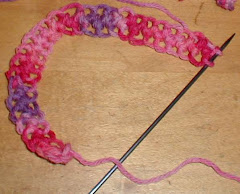
Definitely took me longer than the two days needed to finish Chris's chulo but it's done. The celtic pattern from Alice Starmore's "Charts for Colour Knitting" (out-of-print) was a bear to knit. I'm not sure why as it wasn't particularly complicated with a 10-stitch repeat and less than 25 or so rows. Maybe it was because I was also listening to Karen Cushman's "Catherine, Called Birdy" with DS? I had read the book before but I've already learned I probably shouldn't drive and listen to audiobooks as I arrive safely but can't recall anything about the trip... Maybe it affects my knitting ability or, at least, my ability to follow a charted pattern while listening.

I washed and blocked the hat before presenting it to DH but he insists on turning up the front brim so it will stay as pictured. Also, he likes to play with his hats, turning them this way and that to make new forms, so the ear flaps will probably grow to be twice their beginning length. But it's his and one should always remember that a gift is a gift -- no give-backs, you know, and no "thou shalt do this" with it rules attached. If I tell myself this often enough I'll come to believe AND accept it. I think.

Tuesday, March 9, 2010

Seed-starting, take 1

We intended to start a flat of seeds last month but the ground was still covered with snow and spring seemed a LONG way off. Now it's March, Saturday was sunny while Sunday was sunny AND warm with a high of 61ºF. DH could no longer resist the urge to plant.

On Saturday, he planted 72 pods with a combination of seeds including cabbages (red, green and savoy), cauliflower, broccoli, and lavender. On Monday there were tiny cabbage seedlings pushing through and today the flat looks like this. From left to right, the flat shows sprouts of three different cabbages (Ruby Perfection, Early Jersey Wakefield and Savoy Ace), Early Snowball cauliflower, Calabrese and De Cicco broccoli, Parris Island and Jericho lettuces (romaine or cos lettuces), and a couple of bunching onions in the last two fully visible columns. With 72 cells, DH planted 6 of each variety. Nothing on the right side, out of view in this photo, had sprouted as of this morning but the flat's sitting on the landing near the woodstove and according to the thermometer resting beside it, the temp is a constant 75ºF. so the remaining sweet onions and lavender should be coming along soon.

Sunday's warmer temps encouraged him to weed a couple of beds in preparation for the real spring planting to come. Hopefully in another week, this bed will have sugar snap peas planted at the foot of the wire trellis.
He also put covers on any open cold frames. The soil temperature should rise to allow direct planting in there later this week. Some years we leave the covers on all the cold frames but this year's snows (30", 22", 9" and several lesser ones) didn't seem to melt before the next one hit so DH was worried the weight of a big snow might break the glass in the old window sashes we use for covers. Plus with the nightly temps hanging around 0ºF. and sometimes down to -9ºF. the frames weren't as helpful in prolonging the growing season as they've been in more moderate winters.
The only thing we had to winter over in a cold frame was winter rape. Immediately after taking this picture I picked some and added it to the fried rice I made for lunch. We also like it in a green salad or on sandwiches. For some reason I think egg salad sandwiches are a particularly good fit with Hanover salad as it's sometimes called.

The chickens are still pastured on the rear garden plot, planted with potatoes and pumpkins last year. Usually by this time they'd be on the front beds but, again, the snows caused us to deviate from the regular plans and it's on the ground in areas (notice background in photo below). We'll move them to the next section before the week's out and then on to the last garden area before it's time to plant in earnest. Letting them roam over the garden beds has made a huge difference in the amount of bug damage the garden suffers each summer.