Smokey, the grey silkie bantam, hatched last year is a cockerel.
Determining whether a chick is a pullet or a cockerel can be difficult unless they show specific sex-linked traits like feather barring or color. Smokey was pretty androgynous for the first 6-months. Then between Thanksgiving and Christmas, he began to crow. Good to finally know but bad because we've learned it's rarely a good idea to have two roos in a small flock.
We raise chickens for eggs but we are not vegetarians. We usually process extra cockerels for the freezer. Neither DH nor I wanted that to be Smokey's fate, however. The main reason? Because he's part of our backyard flock -- more pet than livestock. (For additional reasons, see note at bottom of post.) So we needed to find a new home for Smokey.
It needed to be a place where he wouldn't be penned with a full-size rooster as that would be potentially worse than here with us where he only had his sire, Badger, to contend with. We were in luck, tho, as the first person I told about the predicament had a co-worker who might be interested. Another homeschooling family, they were in the process of adding silkie bantams to their homestead flock and offered Smokey a home with a half-dozen silkie bantam pullets. They already had a flock of full-size hens but had built a separate coop to house the silkies. And since silkie bantam roosters are often not as aggressive as full-size roos may be, they were interested in adding a rooster to the bantam flock.
So Smokey moved to his new home last week. And his new family have promised to provide regular updates on him as he settles in at his new place. Good luck, Smokey!
(I love a happy ending.)
Note: More practical reasons for not consigning a silkie bantam to the freezer exist. He probably won't top 2 pounds in weight and he's still growing, not there yet. Another reason is that silkies exhibit melanism where dark pigmentation extends into their connective tissue and even bones. This goes beyond the range of what people call white and dark meat in poultry -- more like a grayish-black or almost purple bruise color. Not palatable-looking to many of those accustomed to the only offer being "white or dark meat?" when chicken is served. Check out the silkie entry on Wikipedia for more information and photos of prepared dishes.
Showing posts with label pets. Show all posts
Monday, February 7, 2011
Monday, August 9, 2010
They grow up so fast
Chickens, that is. (Kids, too, but that's another post.)
Smokey, the grey Silkie chick, (cockerel, we think) is now 10 weeks old. His mama hen, Bandit, a first-timer on the hatching circuit, is like many mothers -- she wants her freedom but she can't quite drop the chick. She's a flyer, always going walk-about in the front yard, visiting the compost pile, that kind of thing. And motherhood didn't change her.
She flew the chick pen the day after Smokey hatched. Fortunately it was warm weather so he wasn't left alone AND cold but we had to put a wire cover on their pen, forcing Bandit to stay in. And that was difficult for Bandit. She paced the fence of her small enclosure, squawking almost constantly about her internment. Poor Smokey spent most of his early days running alongside her trying to keep up so when she did settle down he could scoot underneath for a bit of warm "mama hen time."
DH listened to me debate with myself over whether to leave Smokey in with his seemingly dysfunctional mama hen or foster him in the garage. (He didn't debate because he was not in favor of a chicken in the house. Thin end of the wedge, you know.) I debated because as often happens with our livestock, I'm torn between the food-production side of life and the pet side plus nature vs. nurture -- difficult philosophical subjects here, people!
After the first couple of weeks, we tried letting them both out into the backyard with the other backyard girls (and Snowball's one-week-older chicks) but Smokey couldn't keep up with Bandit's long legs and certainly not with her wings when she would go up and over the fence for a quick compost reccon. So they went back in the closed pen till about 10 days ago.
Then, at almost 9 weeks, it seemed time to let him out with the flock to take his chances in our relatively safe backyard while still, somewhat, under Bandit's tutelage. The neat thing we discovered was while Bandit may head off on her own as usual, Smokey's better able to keep up and, best of all, Bandit is now keeping a protective, if laid-back, eye on her older chick. Now if Smokey cries out -- like when DS picked him up for this photo -- Bandit comes charging to his rescue. Forget the times when she left a newly-hatched chick on his own in the chick pen, she's remembered that she has a responsibility. It's cool to watch their interaction and that of Badger, the grey Silkie roo, who steps in to herd his ladies and any of their chicks as he thinks necessary.
Badger is definitely Smokey's sire and while Mrs. Badger, the other half of our grey Silkie pair, laid the egg, Bandit is his mama hen. Together they make a great chicken family with some human parallels that make for interesting chicken-watching conversations on a slow summer afternoon.

Badger and his "other" families including Snowball and her then-11-week-old chicks: the Turken Twins, Dion the Wanderer and, in front, TBD or the-chick-to-be-named-later.
(Sort of makes me feel I'm reporting for acelebrity rag chicken-expose on polygamous roos but then I'm back to anthropomorphizing...)
Smokey, the grey Silkie chick, (cockerel, we think) is now 10 weeks old. His mama hen, Bandit, a first-timer on the hatching circuit, is like many mothers -- she wants her freedom but she can't quite drop the chick. She's a flyer, always going walk-about in the front yard, visiting the compost pile, that kind of thing. And motherhood didn't change her.
She flew the chick pen the day after Smokey hatched. Fortunately it was warm weather so he wasn't left alone AND cold but we had to put a wire cover on their pen, forcing Bandit to stay in. And that was difficult for Bandit. She paced the fence of her small enclosure, squawking almost constantly about her internment. Poor Smokey spent most of his early days running alongside her trying to keep up so when she did settle down he could scoot underneath for a bit of warm "mama hen time."
DH listened to me debate with myself over whether to leave Smokey in with his seemingly dysfunctional mama hen or foster him in the garage. (He didn't debate because he was not in favor of a chicken in the house. Thin end of the wedge, you know.) I debated because as often happens with our livestock, I'm torn between the food-production side of life and the pet side plus nature vs. nurture -- difficult philosophical subjects here, people!
After the first couple of weeks, we tried letting them both out into the backyard with the other backyard girls (and Snowball's one-week-older chicks) but Smokey couldn't keep up with Bandit's long legs and certainly not with her wings when she would go up and over the fence for a quick compost reccon. So they went back in the closed pen till about 10 days ago.
Then, at almost 9 weeks, it seemed time to let him out with the flock to take his chances in our relatively safe backyard while still, somewhat, under Bandit's tutelage. The neat thing we discovered was while Bandit may head off on her own as usual, Smokey's better able to keep up and, best of all, Bandit is now keeping a protective, if laid-back, eye on her older chick. Now if Smokey cries out -- like when DS picked him up for this photo -- Bandit comes charging to his rescue. Forget the times when she left a newly-hatched chick on his own in the chick pen, she's remembered that she has a responsibility. It's cool to watch their interaction and that of Badger, the grey Silkie roo, who steps in to herd his ladies and any of their chicks as he thinks necessary.
Badger is definitely Smokey's sire and while Mrs. Badger, the other half of our grey Silkie pair, laid the egg, Bandit is his mama hen. Together they make a great chicken family with some human parallels that make for interesting chicken-watching conversations on a slow summer afternoon.
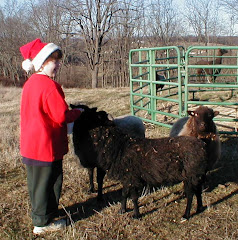
Badger protectively watching over Bandit and a mostly-hidden Smokey -- even Happy Lamb turns from the camera...

Badger and his "other" families including Snowball and her then-11-week-old chicks: the Turken Twins, Dion the Wanderer and, in front, TBD or the-chick-to-be-named-later.
(Sort of makes me feel I'm reporting for a
Saturday, June 19, 2010
R.I.P. Abby
We had to put our Jacob ewe down this morning.
Abby (short for Abilene -- she was named for her hometown, a small Virginia crossroads where she was born over 12 years ago) was a one-of-a-kind sheep. She never completely lost her wariness of people though she learned to like animal crackers, a frequent sheep treat around here. And only in the last few years did she stop giving DH a real run for the money when it came time for shearing and other routine care such as foot trimmings or wormings. More than once she's leaped over the 4-ft gates he set up behind the barn to facilitate capture. The other sheep would gather docilely at the gate after being herded into the pen but not Abby.
We still laugh, DH not so loud, about the time she leaped right over him on a successful attempt to get back out to the field and away from the shearing pen. The funny thing was, once she was in the hands of the shearer (usually DH tho we hired a local Virginia Tech student till DH had a chance to take the 2-day VA/NC Shepherds Workshop then offered down the road at VT's Shenandoah Valley Ag Research and Extension Center at Steeles Tavern), she was a different sheep. Calmly she'd accept her fate and let herself be flipped first one way then the other as the shearer worked to remove her lovely thick coat. Her springy wool made a pretty heathery black yarn as the small splotches of white and brown in her coat blended with the rest of her mostly black wool in the final product. (Her coat would sunburn on the tips making her look more brown as the wool locks lengthened after each shearing but underneath was a rich black.)
Because of her coloring, black legs, black face with a wide white stripe down the middle and a mostly-black coat with a few white and brown patches, many people thought she was a goat on first (or even second) sight -- especially right after shearing when no thick wool gave her away. But we knew she just acted like one. (Myself, I always thought she looked like a holstein calf after shearing.) And as the smallest of the sheep, year in and year out, she would bounce around, trying to exert her dominance, when the others were sheared each spring. I think it's because sheep always look so much smaller right after the shearer finishes and Abby imagined she was now (finally!) the biggest of the flock.
Abby was the sheep that hung back when the others gathered 'round for their treats. She often stayed on the far side of Andy, the guard llama, using him as a shield in case anyone should try to make a grab for her. But with lots of coaxing, over more than a year, animal crackers became too much for her to resist and she finally succumbed to closing in enough that she could share in the bounty, too.
With age, though, she became less agile. We could tell that a couple of years ago when she began putting up only a token chase at shearing time and completely ceased jumping the gates. Early this spring, before DH sheared, she'd even gotten down several times and was unable to stand again without help. Each time it happened, one of us would have to go out and hoist her to her feet.
The good news was it seemed to help her lose most of the remaining shyness with people. Since we'd moved the sheep closer to the house after a serious coyote scare early this past Mother's Day morning, Abby'd even baa and call to us as the other sheep do when we'd be out and about in the backyard -- reminding us that animal crackers were always welcome, I think. We hoped the mobility problem would go away when she was no longer encumbered by her heavy fleece but it didn't and veterinarians, like any other medical doctors, can only offer so much help. It was time.
Abby (short for Abilene -- she was named for her hometown, a small Virginia crossroads where she was born over 12 years ago) was a one-of-a-kind sheep. She never completely lost her wariness of people though she learned to like animal crackers, a frequent sheep treat around here. And only in the last few years did she stop giving DH a real run for the money when it came time for shearing and other routine care such as foot trimmings or wormings. More than once she's leaped over the 4-ft gates he set up behind the barn to facilitate capture. The other sheep would gather docilely at the gate after being herded into the pen but not Abby.
We still laugh, DH not so loud, about the time she leaped right over him on a successful attempt to get back out to the field and away from the shearing pen. The funny thing was, once she was in the hands of the shearer (usually DH tho we hired a local Virginia Tech student till DH had a chance to take the 2-day VA/NC Shepherds Workshop then offered down the road at VT's Shenandoah Valley Ag Research and Extension Center at Steeles Tavern), she was a different sheep. Calmly she'd accept her fate and let herself be flipped first one way then the other as the shearer worked to remove her lovely thick coat. Her springy wool made a pretty heathery black yarn as the small splotches of white and brown in her coat blended with the rest of her mostly black wool in the final product. (Her coat would sunburn on the tips making her look more brown as the wool locks lengthened after each shearing but underneath was a rich black.)
Because of her coloring, black legs, black face with a wide white stripe down the middle and a mostly-black coat with a few white and brown patches, many people thought she was a goat on first (or even second) sight -- especially right after shearing when no thick wool gave her away. But we knew she just acted like one. (Myself, I always thought she looked like a holstein calf after shearing.) And as the smallest of the sheep, year in and year out, she would bounce around, trying to exert her dominance, when the others were sheared each spring. I think it's because sheep always look so much smaller right after the shearer finishes and Abby imagined she was now (finally!) the biggest of the flock.
Abby was the sheep that hung back when the others gathered 'round for their treats. She often stayed on the far side of Andy, the guard llama, using him as a shield in case anyone should try to make a grab for her. But with lots of coaxing, over more than a year, animal crackers became too much for her to resist and she finally succumbed to closing in enough that she could share in the bounty, too. With age, though, she became less agile. We could tell that a couple of years ago when she began putting up only a token chase at shearing time and completely ceased jumping the gates. Early this spring, before DH sheared, she'd even gotten down several times and was unable to stand again without help. Each time it happened, one of us would have to go out and hoist her to her feet.
The good news was it seemed to help her lose most of the remaining shyness with people. Since we'd moved the sheep closer to the house after a serious coyote scare early this past Mother's Day morning, Abby'd even baa and call to us as the other sheep do when we'd be out and about in the backyard -- reminding us that animal crackers were always welcome, I think. We hoped the mobility problem would go away when she was no longer encumbered by her heavy fleece but it didn't and veterinarians, like any other medical doctors, can only offer so much help. It was time.
Wednesday, June 16, 2010
Holly-dog meets a skunk: the aftermath
Holly-dog met a skunk. It was not an amicable meeting. Holly-dog had to have a bath. Immediately.
Always before I've used tomato juice to wash a dog that was sprayed by a skunk but this time DH used a recipe I'd clipped from Country Living. It's inexpensive, I had all the ingredients on hand and I thought it might be easier to wash out of her fur than home-canned tomato juice. I won't know for sure till she gets wet again but this seemed to do a good job.
Dog Bath for Skunk Encounters
32 ounces hydrogen peroxide
1/4 cup baking soda
1 tablespoon shampoo or dish detergent

Mix together right before use. Mixture may fizz or build up pressure in tightly-closed container so don't plan on storing it for another time. Use it all.
Wash, rinse and repeat if you still have soap mixture. Let mixture stay on fur for 5-10 minutes before rinsing.
Bath time is not a favorite with Holly but she's usually very stoic about it. Today you might even say she enjoyed it as DS had something with which to bribe her.
Some friends are on the path to a second adoption from Africa. One of their daughters is contributing to the effort by baking and selling "Rachel's Beefy Biscuits for Dogs." Holly-dog thought they were spot-on.
Always before I've used tomato juice to wash a dog that was sprayed by a skunk but this time DH used a recipe I'd clipped from Country Living. It's inexpensive, I had all the ingredients on hand and I thought it might be easier to wash out of her fur than home-canned tomato juice. I won't know for sure till she gets wet again but this seemed to do a good job.
Dog Bath for Skunk Encounters
32 ounces hydrogen peroxide
1/4 cup baking soda
1 tablespoon shampoo or dish detergent

Mix together right before use. Mixture may fizz or build up pressure in tightly-closed container so don't plan on storing it for another time. Use it all.
Wash, rinse and repeat if you still have soap mixture. Let mixture stay on fur for 5-10 minutes before rinsing.
Bath time is not a favorite with Holly but she's usually very stoic about it. Today you might even say she enjoyed it as DS had something with which to bribe her.
Some friends are on the path to a second adoption from Africa. One of their daughters is contributing to the effort by baking and selling "Rachel's Beefy Biscuits for Dogs." Holly-dog thought they were spot-on.

Wednesday, October 28, 2009
"Life is pleasant. Death is peaceful. It's the transition that's troublesome." -- Isaac Asimov
Fifi, the white Silkie hen, went missing this week. All we've found are clumps of fluffy white feathers in a long trail leading away from her favorite egg-laying spot towards the fence. She had taken to laying her eggs near the old apple tree in a little leafy spot she created just for that purpose instead of in the chicken house. It was off to one corner of our field-fenced backyard, away from where the other backyard girls and chicks typically hang out.Our neighbor's farm pond hosts a fox den. He can watch the kits play there every spring. We've heard the local band of coyotes howl on the other side of the field behind us -- maybe 1/2 mile away. DH surprised what he thinks was a speedy coyote in the fenced backyard late one evening. Andy, the guardian llama, makes sure the sheep are up near the open barn when it's time to turn in at night. He positions the sheep between the barn and himself so he's always on guard. DS and I found a young skunk in the chick pen and, on another occasion, a full-sized skunk inside the electric poultry netting when we went out to close the houses up earlier this summer. We had a feral orange cat this summer who tried to catch the small chicks on occasion. There are predators all around us.
But secretly I've always believed they wouldn't kill any of our animals. You know, I suffered from a variation of the NIMBY or not-in-my-backyard syndrome even though earlier this summer,
Petrock Trelawney's hatchmate, a little cockerel who wasn't around long enough even to secure a name such as Stewpot or Potpie went missing, too. We never found feathers or any sign of what happened to him but he and Petrock (photo on left) had developed the bad habit of hanging back instead of going straight into the house at night. DS and I would have to shoo the two of them in, sometimes resorting to waiting till they had settled into a bush or low-hanging tree branch then plucking them off their perch and stuffing them in the house. One night we couldn't find the cockerel. Either he was well-hidden (to us, at least) or he'd already been nabbed. Whichever way, he was still missing come morning so we concluded he had been devoured by some hungry animal.Fifi will be much missed. She was the best mama hen we've had. Regularly setting on a hatch even in the coldest weather. Always shepherded her fledglings with the stereotypical "mother hen" approach. She stood up to the "big girls" and kept them from bothering her chicks. Even taking on Turkey, the naked neck hen and backyard leader, for their sake. Fifi's sometimes feisty attitude towards other chickens, her blue bill and earlobes (typical of Silkies) and her general cocky yet friendly stance towards us, her people, made her stand out amongst the other backyard girls.
At not quite 6 months old, her daughter, Snowball, hasn't yet shown any indication of broodiness or the strong personality Fifi exhibited but I hope she grows to fill the space her mother left not only in our hatching scheme but in my heart. I miss Fifi. We all do.
Saturday, March 8, 2008
Hooked sampler mat
Today I pulled out my Ashford Country Spinner to start working up some roving from Abby, our Jacob ewe. When I prepared to run the leader through the orifice*, I found my lost rug hook (see previous post). It was stuck through the hole along with a strip of black wool. No wonder I couldn't find it! The handle is the same color as the wheel and I'd never put it there so never thought to look there. DH thought I might be right when I asked if he put it there. For safekeeping, he said. Uh huh.
So the way my mind wanders, I went from sitting down at the wheel to working on the border of my hooked sampler. It was just as well since we've had strong winds of 25-30mph all afternoon and into the night.
Holly dog likes to be close to her humans when bad weather hits. She usually squeezes under my chair when she hears the least rumble of thunder and with gusts up to 60mph, the windows are whistling and rattling to beat the band. This way I could pull the rug frame right up next to her basket so we were both comfortable. She doesn't like a spinning wheel near her when it's in motion.
Holly dog is looking especially clean today as she wallowed in the mud this morning and had to have a bath before lunch. Fortunately it wasn't windy then and the outdoor temperature was almost 60F. so DH gave her a bath in the washtub on the back deck. Holly is not known for appreciating bathtime and we've learned the hard way not to attempt to bathe her in the bathtub. It's either the back deck or the garage for Holly's ablutions.
I set out to make myself a sampler to show how different weave patterns will look when hooked. Since I like functional samplers, this one is destined to be a mat on the top of a little 4-drawer dresser I use as a side table in the living room.
It's proving very helpful as several of the fabrics have turned out different from the way I imagined they would look when hooked. Good to know when I start planning my next hooked projects.
The hooking frame by The Purple Crow was a Christmas gift from my mother-in-law a couple of years ago. I also received another base that lets me support the frame above my lap if I'm sitting in a chair where use of the floor frame is impractical. The head frame has stainless steel grippers on all four sides that make repositioning easy but hold tight while hooking.
I especially like the way I can maneuver the frame around chair legs and even the footstool while not having to worry about frame legs to the side getting in the way. I have a needlework scroll frame (think small quilting frame) that I like but it's only useful if I want to sit in a straight kitchen table-style chair. Even the narrow wingback chair I favor in the living room won't allow me to pull that frame close-in while I work.
Hoping to finish this mat before next weekend so I can start another hooking project -- perhaps a top for my large footstool or chair pads for the kitchen chairs. I keep vacillating between traditional rug hooking and locker hooking. There are four main chairs and several extras we only pull out as needed. Maybe I could make a different type of pad for each?
Well, that's the least of my worries right now. I just need to concentrate on finishing this sampler.
*Are both the openings termed the orifice? I've always called the one to the front where the fiber enters (perpendicular to the floor) by that term but when I went to describe it here I was caught up short. The hook was in the opening behind that first entry point. The second orifice?
So the way my mind wanders, I went from sitting down at the wheel to working on the border of my hooked sampler. It was just as well since we've had strong winds of 25-30mph all afternoon and into the night.
Holly dog is looking especially clean today as she wallowed in the mud this morning and had to have a bath before lunch. Fortunately it wasn't windy then and the outdoor temperature was almost 60F. so DH gave her a bath in the washtub on the back deck. Holly is not known for appreciating bathtime and we've learned the hard way not to attempt to bathe her in the bathtub. It's either the back deck or the garage for Holly's ablutions.
I set out to make myself a sampler to show how different weave patterns will look when hooked. Since I like functional samplers, this one is destined to be a mat on the top of a little 4-drawer dresser I use as a side table in the living room.
The hooking frame by The Purple Crow was a Christmas gift from my mother-in-law a couple of years ago. I also received another base that lets me support the frame above my lap if I'm sitting in a chair where use of the floor frame is impractical. The head frame has stainless steel grippers on all four sides that make repositioning easy but hold tight while hooking.
I especially like the way I can maneuver the frame around chair legs and even the footstool while not having to worry about frame legs to the side getting in the way. I have a needlework scroll frame (think small quilting frame) that I like but it's only useful if I want to sit in a straight kitchen table-style chair. Even the narrow wingback chair I favor in the living room won't allow me to pull that frame close-in while I work.
Hoping to finish this mat before next weekend so I can start another hooking project -- perhaps a top for my large footstool or chair pads for the kitchen chairs. I keep vacillating between traditional rug hooking and locker hooking. There are four main chairs and several extras we only pull out as needed. Maybe I could make a different type of pad for each?
Well, that's the least of my worries right now. I just need to concentrate on finishing this sampler.
*Are both the openings termed the orifice? I've always called the one to the front where the fiber enters (perpendicular to the floor) by that term but when I went to describe it here I was caught up short. The hook was in the opening behind that first entry point. The second orifice?
Subscribe to:
Posts (Atom)